Sound Limiters at Wedding Venues
What Couples Need to Know
Know the Limit
A sound limiter won’t stop the party if you plan for it before booking your entertainment.
You’ve booked the wedding band, picked your first dance and pictured your wedding reception in full swing, the room full of your favourite people dancing. Then the venue mentions a sound limiter, and suddenly you’re not sure what that means for the night.
It’s more common than most couples realise, especially in listed buildings and at venues with neighbours close by. Knowing how a sound limiter works before you book your entertainment saves a lot of stress later, and it’s the difference between a dancefloor that runs all night and a band that keeps getting cut off mid-song.


What is a sound limiter?
A sound limiter is a device that measures the volume in a room and cuts the power to your sound system if the music goes over a set level. It’s usually fitted near the performance area or wired into the electrics that the band or wedding DJ plugs their sound equipment into. When the sound goes above the threshold for a few seconds, the limiter trips and the power drops out.
The limit is set by the venue, often as a condition of their entertainment licence, and it’s measured in decibels (dB). Some venues set it high enough that you’d barely notice. Others set it low enough that a full band can’t play at full volume without tripping it. The figure is what matters, and it’s worth getting it from the venue in writing.


Why are there sound limiters at wedding venues?
Sound limiters, sometimes called noise limiters, aren’t the venue’s fault. Most of the time they’re fitted because the venue has to meet a condition to host live music at all.
The usual reasons come down to:
A council environmental health officer often sets the level based on where the venue sits and how close the neighbours are, keeping the venue clear of complaints and potential action on its entertainment licence. Once that limit is in place, these venue restrictions apply to you and your entertainment too.
How sound limiters affect live music
When the music creeps over the threshold, the limiter trips and the power to the stage cuts out. A few seconds of silence, then the band plugs back in and starts again. Do that a few times in one set and the party atmosphere goes with it.
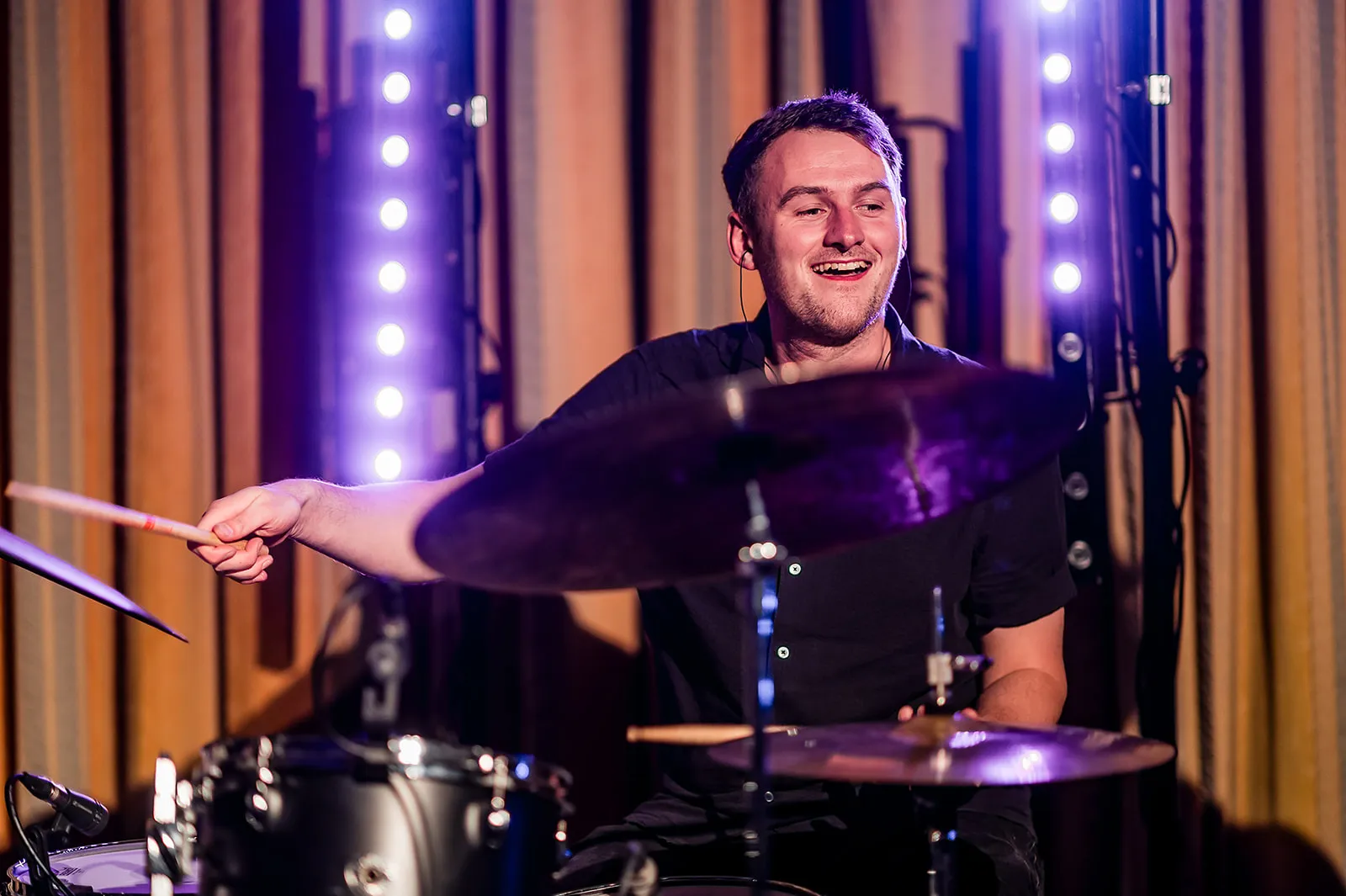
Drums and bass are usually the first things to trigger it. A live drum kit is loud at the source and hard to turn down, and the low notes of a bass guitar pushed through an amplifier register loudly on the limiter’s microphone, so the noise level climbs fast even when the room doesn’t feel that loud.
That’s why live wedding bands at full volume can struggle in venues with a low volume limit. The band can play, but not the way you heard them at a showcase, and a wedding venue sound limiter set too low can flatten a set that would otherwise fill the floor.
What is the sound limit at a wedding venue?
There’s no single answer, since the limit changes from venue to venue. Here’s how everyday sounds compare:
60dB
Normal conversation
85dB
Heavy traffic
95–100dB
A busy pub or a live band
Most wedding venue limiters are set somewhere between 85 and 100dB.
95dB and above
Most bands have room to play at proper sound levels, and you’d barely know the limiter was there.
Around 90dB
A full band with live drums has to hold back, so you lose the full-volume performance.
Below 85dB
Amplified live music is very hard to pull off, because a band simply can’t get loud enough to fill the room. You’re better looking at quieter options than fighting the meter all night.
The two types of sound limiter
There are two kinds of limiter, and the difference matters a great deal.
Traffic light system
Many limiters run on a traffic light system:
A good act can ride the amber all night and never actually trip it.
Hard cut-out
The other kind is a hard cut-out with no warning. The moment the sound goes over, the power dies.
There’s no chance to react, which makes these far harder to work with.
When you ask about your venue’s limiter, this is the thing to pin down, because a warning system and a hard cut-out call for completely different setups.
How to find out if your venue has a limiter
Venues don’t always mention a limiter upfront, so it’s worth asking directly rather than assuming the room is clear. Ask about noise restrictions before you book a band or DJ, and ideally before you book the venue if live music is a priority for you.
Ask for the actual decibel figure, not just a yes or no. ‘We have a limiter’ tells you very little, but ‘it’s set to 92dB on a traffic light system’ tells you exactly what your band needs to know. If the venue has a supplier information pack, the limit is normally listed in there alongside access times and setup details.
Questions to ask your venue about sound levels
Get those answered early and there are no surprises on the day. The answers also tell your band or DJ everything they need to plan the right setup for the room.
How the right wedding band or DJ works around a limiter
Experienced acts play within limiters all the time, and there’s plenty they can do once they know the limit.
Electronic drum kits
Electronic kits bring the loudest element right down.
Amp modelling and DI boxes
They keep guitars and bass under control without losing the sound.
A smaller line-up
A band can scale back the line-up to suit the room.
Careful DJ levels
A DJ can manage levels through the night to keep the party going without tripping the meter.
The one thing that makes all of this work is telling your entertainment the limit early. A sound limiter wedding band booking goes smoothly when the act knows the figure at the point of booking, not when they arrive and see the box on the wall. Give us the venue and the limit when you enquire, and we’ll match you with acts set up to handle the room.
Low-volume and acoustic alternatives
For venues with a tight limit, the answer often isn’t a smaller party band, it’s a different kind of act altogether. An acoustic band or duo works comfortably under most limiters and fills the room without a loud PA or live drums pushing the meter over the edge. Smaller line-ups, roaming performers and solo singers all work where volume is capped.
An acoustic singer for the ceremony and drinks, then a DJ-led evening, keeps the music going from start to finish without ever troubling the meter. Our acoustic wedding singers are a popular choice for exactly this. You don’t have to choose between a packed dance floor and a venue you love.

FIND THE RIGHT ACT FOR YOUR VENUE
A sound limiter isn’t a reason to compromise on the music. It just means getting the right act for the room and briefing them early.
If your venue has a limiter and you’re not sure what you can book, that’s the kind of thing we sort out every week. Tell us your venue and the limit, and we’ll match you with wedding entertainment set up to keep the night going. Get in touch and we’ll take it from there.